Security Foundations — Networks, the OSI Model, and How a SOC Works
My working notes on the fundamentals every defender needs — what a network is, the OSI and TCP/IP models, protocols, the shared responsibility model in the cloud, and how blue teams and SOC analyst tiers fit together.
Overview
Before firewalls, SIEM rules, or incident response make sense, you need a solid picture of how data actually moves and who is responsible for protecting it. This post is my living set of study notes on those foundations. I update it as I learn, so expect it to grow.
What’s covered:
- What a network is, and LAN vs WAN
- The OSI model, layer by layer
- The TCP/IP model and how it maps onto OSI
- Protocols
- Cloud security and the shared responsibility model
- Red, blue, and the SOC: who does what
- Device protection basics for mobile
- What I’m studying next
This is a study log, not a complete reference. If you spot something wrong or outdated, I’d genuinely like to hear about it.
Part 1: Networking Basics
What is a network?
A network is a group of connected devices that can exchange data and share resources. Two vocabulary words come up constantly:
| Term | Meaning |
|---|---|
| Node | Any individual device on the network (laptop, phone, printer, server) |
| Link | The pathway between nodes, either wired or wireless |
LAN vs WAN
Networks are usually described by how far they stretch:
- LAN (Local Area Network): covers a small area such as a home, a classroom, or one office building.
- WAN (Wide Area Network): links networks across cities, countries, or continents. The internet is the biggest WAN.
Typical traits of a LAN:
| Trait | What it looks like |
|---|---|
| Scope | A single building or campus |
| Ownership | Usually one person or organization |
| Speed | High throughput between devices |
| Media | Ethernet cabling, Wi-Fi, or both |
Why networks matter
Almost everything we rely on runs over a network: shared printers and files, messaging and video calls, access to databases from any device, and real-time collaboration across distances. It also means almost every attack path runs over one, which is why defenders study them first.
Part 2: The OSI Model
The Open Systems Interconnection (OSI) model splits network communication into seven layers. It’s a conceptual framework, not a protocol you can install. Its value is that it gives everyone a shared vocabulary: when someone says “that’s a Layer 2 problem,” you know roughly where to look.
Here is how I remember each layer, from the bottom up:
| # | Layer | What it does | Examples |
|---|---|---|---|
| 1 | Physical | Moves raw bits over a physical medium | Ethernet cables, hubs, repeaters |
| 2 | Data Link | Node-to-node delivery within a local network, with framing and error detection | Switches, bridges, MAC addresses |
| 3 | Network | Logical addressing and routing between networks | Routers, IP addresses |
| 4 | Transport | End-to-end delivery, segmentation, flow control | TCP, UDP |
| 5 | Session | Opens, maintains, and closes conversations between applications | Session protocols, APIs |
| 6 | Presentation | Translates data formats; handles encryption and compression | Encryption, compression |
| 7 | Application | The interface that network services expose to user-facing software | HTTP, FTP, SMTP, DNS |
A classic mnemonic for the order from Layer 7 down to 1 is “All People Seem To Need Data Processing.”
A few layers worth remembering
- Layer 2 uses MAC addresses to identify devices on the same local network. Switches work here.
- Layer 3 uses IP addresses and decides the path packets take across networks. Routers work here.
- Layer 4 is where the reliability trade-off lives:
- TCP is connection-oriented and recovers from lost data. Slower, dependable.
- UDP is connectionless with no delivery guarantee. Faster, lighter.
- Layer 7 is not “the application itself.” It’s the layer that gives applications access to network services, such as a browser speaking HTTP or a mail client using SMTP.
Part 3: The TCP/IP Model
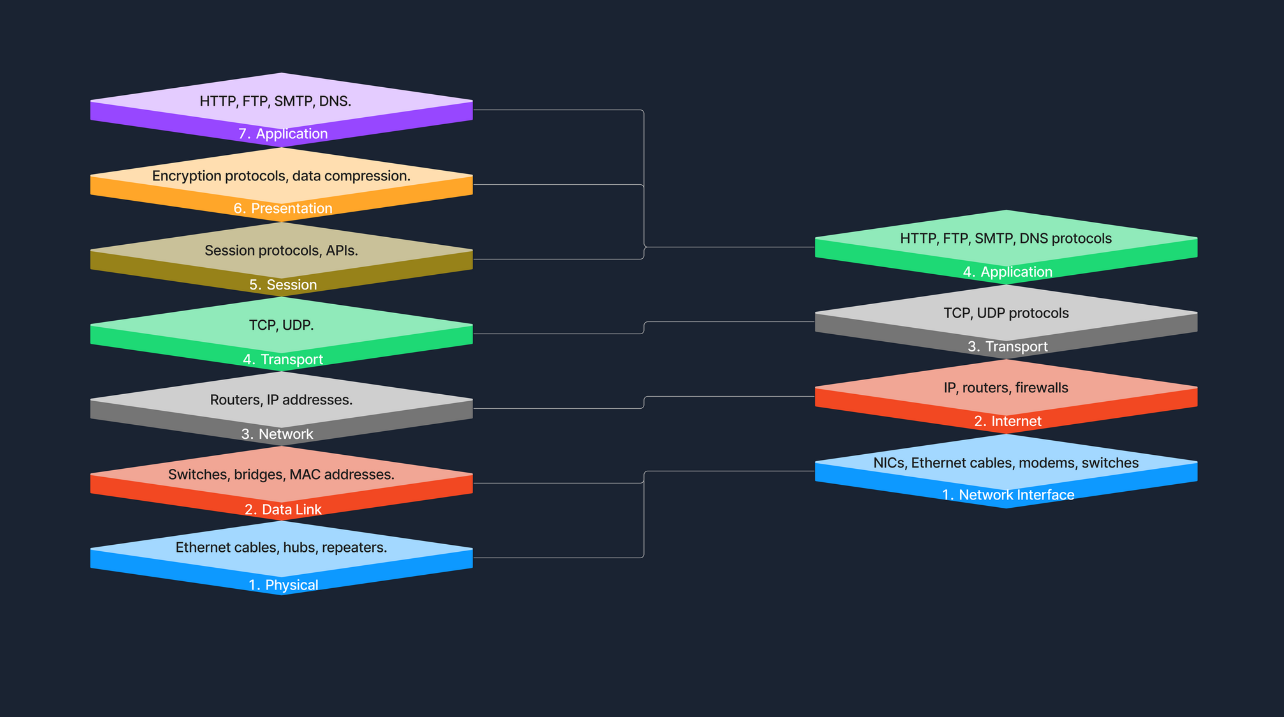
The TCP/IP model is the more practical, condensed version of OSI, and it’s the one the real internet is built around. It has four layers:
| TCP/IP layer | Roughly equals (OSI) | Examples |
|---|---|---|
| Application | Application + Presentation + Session (7, 6, 5) | HTTP, FTP, SMTP, DNS |
| Transport | Transport (4) | TCP, UDP |
| Internet | Network (3) | IP, ICMP, routers |
| Link (Network Interface) | Data Link + Physical (2, 1) | NICs, Ethernet, Wi-Fi, switches |
The seven OSI layers on the left, mapped to the four TCP/IP layers on the right
The takeaway: OSI is what you use to reason and troubleshoot, and TCP/IP is what’s actually running.
Part 4: Protocols
Protocols are agreed-upon rules for how data is formatted, sent, and processed so that different devices can understand each other. Some you’ll meet on day one:
| Protocol | Role |
|---|---|
| TCP | Reliable, ordered delivery |
| UDP | Fast delivery without guarantees |
| FTP | File transfer |
| SMTP | Sending email |
| HTTP | Web traffic |
| DNS | Turning domain names into IP addresses |
Each protocol’s behavior is also its attack surface, which is why so much of security work is knowing what “normal” looks like for each one.
Part 5: Cloud Security and Shared Responsibility
In the cloud, security is split between you and the provider. This is the shared responsibility model.
Think of a safe deposit box at a bank. The bank provides the building, the vault, the guards, and the cameras. But you hold the key and decide what goes inside. If you leave the key lying around, that’s not the bank’s failure.
| The provider secures | You secure |
|---|---|
| Physical data centers | Your data |
| Underlying infrastructure | Your applications |
| Core hardware and hypervisor | Access, identities, and configuration |
The exact split shifts depending on the service model (IaaS, PaaS, SaaS), so always check where the line falls for the service you’re using.
Related topics I’m tracking under this heading: disaster recovery and business continuity, the plans that decide how quickly an organization can get back on its feet after an incident.
Part 6: Red, Blue, and the SOC
Threat actors and blue teams
A threat actor “team” is an organized group of people with specialized skills working together to carry out cyber attacks. The defenders on the other side are the blue team, whose work falls into four areas:
| Area | What it means |
|---|---|
| Continuous monitoring | Watching systems and networks for suspicious activity |
| Implementing security controls | Putting preventive and detective protections in place |
| Incident response | Containing, investigating, and recovering from incidents |
| Collaboration and training | Sharing knowledge and keeping skills sharp |
The Security Operations Center (SOC)
The SOC is the blue team’s home base: a function whose job is to watch over an organization’s digital environment around the clock. Analysts are typically organized in tiers:
| Tier | Role |
|---|---|
| Tier 1 | Initial alert triage and basic threat analysis |
| Tier 2 | Complex incidents, deeper investigation, and mentoring Tier 1 |
| Tier 3 | Incident response leads; the most critical issues and advanced threat analysis |
For me this is the most relevant part of these notes. Working through how a SOC runs is a big part of why I’m building toward a career in finance and banking security, where monitoring and incident response matter enormously.
Part 7: Device Protection (Mobile)
Protecting a mobile device isn’t one control. It’s several layers, each covering a different weakness:
| Layer | Focus |
|---|---|
| Device security | The phone itself: lock screen, updates, encryption, remote wipe |
| Data security | What’s stored and how it’s protected |
| Network security | Wi-Fi, VPN, and how the device connects |
| Application security | What apps are installed and what permissions they hold |
I’ll expand each of these into its own section as I work through mobile security.
What’s Next
My study roadmap, which future posts will pick up:
- IDS / IPS: detecting and blocking suspicious traffic
- SIEM: collecting and correlating logs for the SOC
- Firewall configuration: how rules are designed and tested
- Cloud security, OPSEC, AppSec, NetSec, and MobSec deep dives
Key Takeaways
- Know the layers. OSI gives you the vocabulary, TCP/IP shows you the reality, and knowing both makes troubleshooting and analysis faster.
- Know normal to spot abnormal. Every protocol has expected behavior. Detection starts there.
- Responsibility is shared. In the cloud, the provider secures the platform but you still own your data and configuration.
- Defense is a team sport. A SOC works because tiers, tools, and training fit together.
References
Open Systems Interconnection model. https://en.wikipedia.org/wiki/OSI_model
MAC address. https://en.wikipedia.org/wiki/MAC_address
HTB Academy. https://academy.hackthebox.com/